

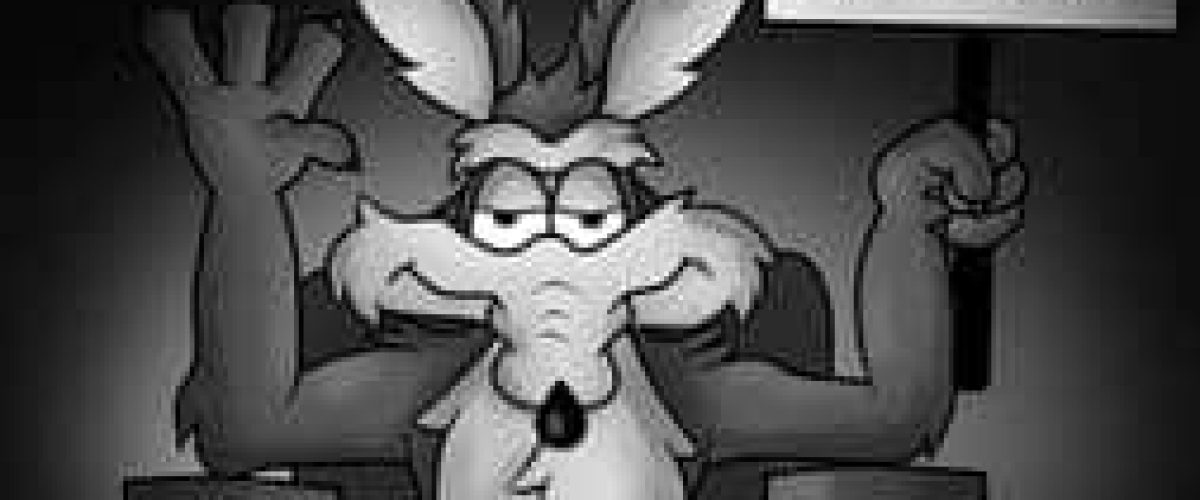
If any fictional character has ever needed a personal injury lawyer, it is Wile E. Coyote.
Consider the file: rocket skates that rocket in the wrong direction, giant magnets with questionable quality control, spring-loaded contraptions, exploding devices, falling boulders, and enough cliff-related trauma to make an insurer’s claims department simply close for the day.
For decades, Wile E. absorbed it all, shook off the dust, unfolded himself like an accordion and went back to work.
In Coyote vs. Acme, released in Canadian theatres on August 28, 2026, he finally tries something different: he hires a lawyer.
The film’s wonderfully ridiculous premise has Wile E. Coyote suing the Acme Corporation over the products that have repeatedly failed, and injured, him. Will Forte plays Kevin Avery, the lawyer who takes his case, while John Cena appears on the other side for Acme. Beneath the Looney Tunes physics and courtroom comedy, however, there is a surprisingly real legal question…
When A Product Causes an Injury, Who Is Responsible?
If Wile E. Coyote lived in Ontario instead of the American Southwest, the answer would be more complicated than “Acme, obviously.”
Canadian product liability law is rooted largely in negligence. Manufacturers can owe duties concerning the safety of their products and the warnings that accompany them. The Supreme Court of Canada has confirmed that a manufacturer has a duty to warn consumers about dangers it knows, or ought to know, are inherent in the ordinary use of a product.
Depending on the case, an injured person may need to establish a defective product or inadequate warning, a breach of the applicable standard of care, causation, and actual damages.
That last part matters. A bad product is not automatically a personal injury case. There still has to be an injury and a legal connection between the defendant’s conduct and the harm suffered.

What If The Injured Person Was Also Taking A Risk?
And then there is the awkward issue Acme’s defence lawyers would undoubtedly raise: Wile E. himself.
Anyone who has watched a Road Runner cartoon knows our plaintiff is not exactly risk-averse. He routinely straps explosives to his body, launches himself from homemade catapults, and stands beneath suspended anvils with remarkable confidence.
In Ontario, where an injured person’s own negligence contributed to a loss, responsibility can be apportioned between the parties under the Negligence Act. In other words, Acme might be negligent, but Wile E. could still receive an uncomfortable percentage of the blame.
That is not just cartoon logic.
Real personal injury cases are rarely as simple as “someone got hurt, therefore someone else pays.” Lawyers look closely at how an accident happened, what each person knew, whether a danger should have been anticipated, what warnings were given, and whether the injury could reasonably have been prevented.
What Compensation Can An Injured Person Claim?
The consequences matter too.
In real life, people do not pop back into shape after being flattened by a steamroller.
A serious injury can mean months of treatment, time away from work, reduced earning capacity, future care needs, pain, and the loss of ordinary parts of life that used to be taken for granted. Personal injury law is ultimately about putting a value, imperfectly, but necessarily, on those very human losses.
What Coyote vs Acme Gets Right About Personal Injury Law
There is also a practical lesson Wile E. might appreciate: time matters. In Ontario, the basic limitation period for many civil claims is generally two years from the date the claim is discovered, although exceptions apply and discoverability can be fact-specific.
At Bergeron Clifford Injury Lawyers, those are the kinds of questions we ask when someone has been seriously injured: what happened, why did it happen, who bears responsibility, and what will this injury mean for the person’s future?
So perhaps the strangest thing about Coyote vs. Acme is not that a cartoon coyote finally sues a corporation.
It is that it took him this long.
For more than seventy years, Wile E. kept ordering from the same company, opening the same crates, and trusting the same little instruction manuals. Maybe that is the film’s best legal joke, and its most useful real-world one.
Persistence is admirable.
But sometimes, after the dust clears and the anvil lands, the smarter move is to stop chasing the Road Runner and start asking the right questions. Contact us today.


